Shikshana Mahiti — September 2025
September 1, 2025
National News

Major Organizations Commit to Supporting AI Education.
The UGC has approved the establishment of campuses of 5 prestigious international universities in India between 2026 and 2027.

The Global Education and Training Institute (GETI) has launched the “Hi PATH” app in over 10,000 Indian schools, introducing a real-time, digital classroom assessment platform powered by OMR scanning and ALfA pedagogy.
The AICTE has introduced new guidelines requiring Ph.D candidates in technical education to disclose any use of artificial intelligence (AI) in their theses.
CBSE has launched 14 new Capacity Building Programmes (CBPs) for teachers, aligning classroom practice with the National Education Policy (NEP) 2020.
NCERT has decided to give equivalence to 10th and 12th class certificates for admission in school education boards and government jobs
Edu-Prism
Faculty Capacity Building at Higher Education Institutions: Gaps, Challenges and Way Forward
Higher Education Institutions play a crucial role in preparing future-ready citizens by equipping students with critical thinking, problem-solving skills and industry-relevant expertise. To realize their role in societal transformation, HEIs must continuously improve their institutional capacities in terms of academic, administrative, digital and infrastructural aspects. Rapid changes in technology, pedagogy and global competitiveness demand enhanced faculty competencies in higher education. But, the current process of recruiting the faculty members at higher education institutions does not mandate formal teacher education qualification. The lack of formal training and knowledge of the pedagogical methods affects the quality of teaching. In this context, the faculty capacity building programmes serve as an important mechanism for equipping the faculty with the skills and competencies required to enhance their teaching and research abilities in line with the goals of NEP 2020.
In the academic world, the capacity building is viewed as a continuous and dynamic process for developing and strengthening faculty skills, enabling them to adapt to the changing educational landscape and enhance their effectiveness in addressing the challenges. Faculty capacity building in India began in the 1980s with Academic Staff Colleges (now UGC-HRDCs) to improve teaching and research skills. Since then, several national initiatives—such as PMMMNMTT, Guru Daksha (FIP), ARPIT, SWAYAM-MOOC and AICTE’s ATAL Academy—have expanded training opportunities for faculty across disciplines. These on-going faculty professional development programmes encompasses participation in structured training programmes, workshops and exposure to cutting-edge pedagogical techniques and research advancements to enhance their proficiency. However, the process of implementation of such initiatives faces considerable challenges specifically regarding the preparedness of faculty members to adopt new teaching methods and integrate latest technologies in teaching and learning.
Faculty capacity building in India has progressed from fragmented workshops to more structured and policy-aligned efforts under various initiatives. However, significant challenges remain such as inadequate funding, time constraints, inadequate institutional support, lack of sufficient infrastructure, lack of effective monitoring, follow up and impact assessment of teaching and learning and availability of effective resource persons. Additionally, the systemic challenges to faculty capacity building include uneven access, low motivation of faculty to participate in FDPs or implement new practices, and the prevalence of one-size-fits-all program models overlooks institutional diversity, disciplinary requirements, and career stages, leading to limited long-term impact. The major gaps include lack of faculty need assessment, insufficient hand-on training and technological challenges and lack structured framework for capacity building programmes.
As Indian higher education moves toward NEP 2020’s goals of flexibility, equity and excellence, strengthening institutional ecosystem and promoting need-based training programmes while promoting evidence-based models are necessary. These efforts are crucial in preparing a dynamic and future-ready teaching workforce to meet the institutional goals while contributing to the transformative aspiration of National Education Policy 2020 and vision Viksit Bharat @2047.
Ms. Latha N
Assistant Professor, CESS
Karnataka News
Minister for School Education Madhu Bangarappa, said that the State government will establish 800 new Karnataka Public Schools this year.
Karnataka State Government is showing interest in skill-based program in higher education.

In order to provide quality school education in Kalyan Karnataka and rural areas, the state government and Kalyan Karnataka Region Development Board (KKRDB) will set up 350 Karnataka public schools in the next two years, said KKRDB Chairman Ajay Singh.
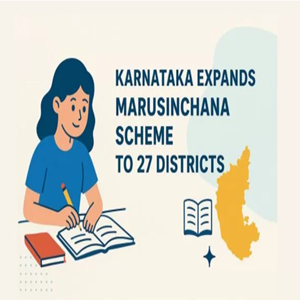
Karnataka govt has announced the expansion of the Marusinchana scheme to 27 educational districts, targeting students from classes VI to X who are lagging in their studies.
The Karnataka School Education and Literacy Department has signed an agreement with EkStep Foundation to provide lessons using artificial intelligence (AI) to over 1000 government schools.
The Karnataka Cabinet approved a new Karnataka State Skill Development Policy worth Rs 4,432 crore, which covers a 7-year period up to 2032.
Voices on Education

Sruthy Susan Ullas writes Karnataka & UK look to deepen higher education ties.
Centre for Educational and
Social Studies
The Centre for Educational and Social Studies (CESS) is a registered society established in 2006. Since its inception CESS has been working in the field of education. CESS, guided by its vision of bringing about ‘Social Transformation Through and With Education’ is striving to draw the attention of stakeholders, including State and Central Government, on vital issues of education. We at CESS engage in Research, Policy Advocacy and Capacity Building in the broad sphere of Education. In the recent past, since the unveiling of NEP, CESS has conducted over 100 webinars and stakeholders consultations on policy awareness and on policy implementation and has reached out to more than 30,000 stakeholders of education. CESS has launched ‘NEP Ready’-a capacity building training workshops to facilitate HEIs in the effective implementation of NEP 2020.
Disclaimer: This document is being presented to you for your information. The information and opinions in the news articles contained in Shikshana Mahithi are captured from the government websites and authors of the articles. CESS is a not-for-profit organization and does not endorse the presented news.