Shikshana Mahiti — November 2022
November 1, 2022
Announcements from the Govt. Bodies
University Grants Commission has invited suggestions/feedback on Draft UGC (Institutions Deemed to be Universities) Regulations, 2022.
The UGC has released the University Grants Commission (Categorization of Universities (Only) for Grant of Graded Autonomy) (First Amendment) Regulation, 2022.
The UGC regulations which set the minimum standards and procedure for the award of, Ph.D. have been revised according to the recommendations of National Education Policy 2020 and the UGC has notified the new UGC (Minimum Standards and Procedure for the Award of Ph.D.) Regulations, 2022 in the Official Gazette.
Ministry of Education releases report on Performance Grading Index for States/UTs for the year 2020-21.
National News

Government constitutes a High Level Committee for strengthening the Assessment & Accreditation of Higher Educational Institutions.
The All India Council for Technical Education (AICTE) launched outcome based educational books for diploma and under-graduate engineering courses in Marathi language.
UNESCO has released the Global Education Monitoring (GEM) report, South Asia Non-State Actors in Education: Who Chooses? Who Loses?
Education Minister Dharmendra Pradhan launches portal for selection of PM Shri schools
The Education Ministry has added a new category - Agriculture & Allied Sectors for NIRF rankings 2023. Along with this, the MoE has also renamed the Architecture discipline as Architecture and Planning.
The proposed Higher Education Commission of India (HECI), which will subsume the University Grants Commission (UGC) and All India Council for Technical Education (AICTE), is likely to have extensive penal powers.
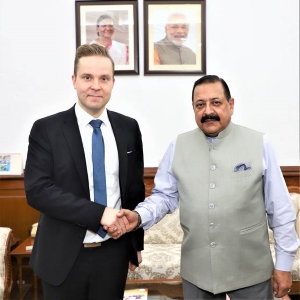
India and Finland agree to carry mutual cooperation between the two countries to a new level and enhance partnership in areas such as Digital Partnership in Future ICT, Future Mobile Technologies and Digital Education.
Based on recommendations by the National Education Policy (NEP) 2020, the Central Board of Secondary Education (CBSE) has said it will announce a new format for the next academic year and will plan to do away with the current 10+2 system and move towards a 5+3+3+4 pedagogical structure.
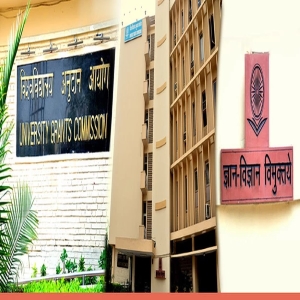
The University Grants Commission (UGC) has finalised the framework for the four-year undergraduate programme (FYUGP) that will be implemented in all higher education institutions from the upcoming academic session 2023-24.
The UGC will soon release guidelines for universities looking to set up satellite campuses abroad to the public for feedback from stakeholders, UGC chairperson M Jagadesh Kumar said.
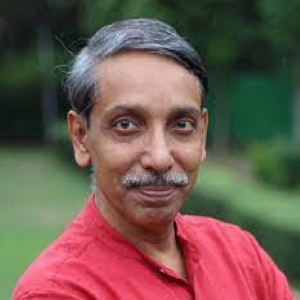
The higher education regulator, in collaboration with the Bharatiya Bhasha Samiti, a panel of experts under the Union ministry of education to promote Indian languages, will soon notify an apex committee to prepare the plan.
Karnataka News
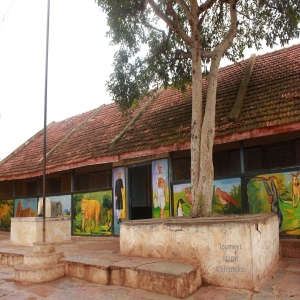
The Karnataka Border Area Development Authority (KBADA) had asked the vice-chancellors of the universities to conduct a scientific study of educational infrastructure, socio-economic factors and cultural conditions in the 63 taluks of these districts.
The Department of School Education and Literacy has issued a revised order on the age limit for admission to class 1. Kids should have completed six years by June 1 to enrol for class 1 in the state schools from the academic year 2025-26.
One of the highlights of the National Education Policy (NEP) is the option for students to exit at multiple levels of their course. In Karnataka, no undergraduate student from the maiden NEP batch has taken the exit option after completing first year.
the Karnataka school education department has released a list of 13,363 candidates, including three transgenders, for a total of 15,000 graduate primary teacher posts for Classes VI, VII and VIII in government schools.

Voices on Education

Badri Narayan writes: How National Curriculum Framework Is the Master Key to Unlock the Potential of NEP
Devika Rae Chandra & Arindam Ghosh write: Schools in Tier I cities fare better in infrastructure, access and learning outcomes, but those in rural India are still lagging, with stark disparities across states.

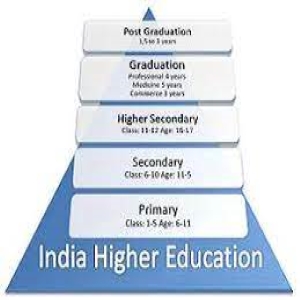
Sanjay Bhatnagar writes: Reimagining Higher education in India
Dr Bharat S Pandya writes: India’s education marks recovery: Digital Tools and Empathy to play a big role.
Pooja Pandey writes: Decoding the National Credit Framework (NCrF)
Centre for Educational and
Social Studies
The Centre for Educational and Social Studies (CESS) is a registered society established in 2006. Since its inception CESS has been working in the field of education. CESS, guided by its vision of bringing about ‘Social Transformation Through and With Education’ is striving to draw the attention of stakeholders, including State and Central Government, on vital issues of education. We at CESS engage in Research, Policy Advocacy and Capacity Building in the broad sphere of Education. In the recent past, since the unveiling of NEP, CESS has conducted over 100 webinars and stakeholders consultations on policy awareness and on policy implementation and has reached out to more than 30,000 stakeholders of education. CESS has launched ‘NEP Ready’-a capacity building training workshops to facilitate HEIs in the effective implementation of NEP 2020.
Disclaimer: This document is being presented to you for your information. The information and opinions in the news articles contained in Shikshana Mahithi are captured from the government websites and authors of the articles. CESS is a not-for-profit organization and does not endorse the presented news.